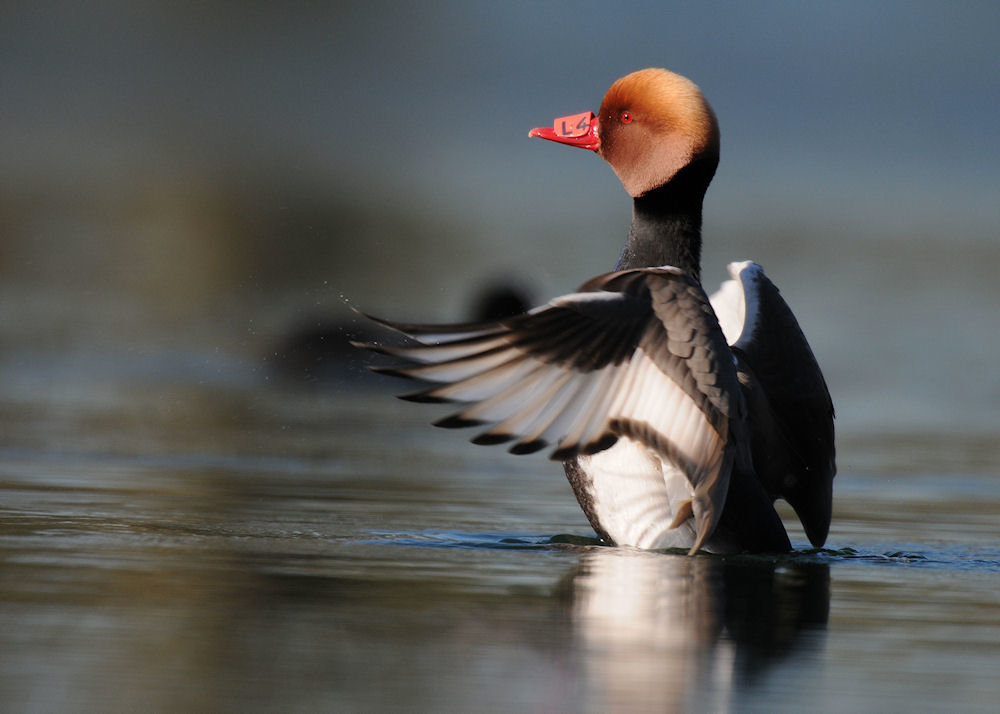
L4
| Eingestellt: | 2010-04-13 |
|---|---|
| RG © | |
| Dieses Kolbenente-männchen mit der merkwürdigen Markierung konnte ich auf einem Weiher fotografieren.Sie stammt südlich von Paris. |
|
| Technik: | Nikon D 300 Nikon 4/600 mm F/5,6 -0,3 1/1250 sek. ISO-320 |
| Natur: | Naturdokument ? |
| Größe | 246.9 kB 1000 x 714 Pixel. |
| Ansichten: | 5 durch Benutzer259 durch Gäste632 im alten Zähler |
| Rubrik Vögel: | |


Re: L4
tolle Pose,tolles motiv und dazu noch eine interessante Erklärung.
Die Aufnahme gefällt mir sehr gut und das Kippen lässt sich shnell korrigieren .
.
LG
Michael
Re: L4
so eine Markierung habe ich auch noch nicht gesehen und ehrlich gesagt gefällts mir auch nicht und gebe zu bedenken, dass es evtl. störend beim Putzen sein kann, auch kann sich da Schmutz und Bakterien unter diese Markierung setzen. Beringung halte ich da wirklich für angebrachter, auch wenn es bei Wasservögeln natürlich sehr schwer ist dann eine Bestimmung zu machen, aber ich bin beiweitem kein Profi, deswegen betone ich, dass es meine persönliche Meinung ist.
Das Foto ansonsten ist dir supergut gelungen, ganz tolle Pose.
LG
Marion
Re: L4
Schnabelmarkierungen sind bei Enten nicht ungewöhnlich. Diese individuellen Markierungen erleichtern die Identifikation des Vogels auf größere Entfernungen.
Auf www.cr-birding.be/ sind fast alle europäischen Farbmarkierungsprogramme mit Kontaktdaten aufgeführt:
Red nasal-saddles with black code and metal ring.
Raphaël Musseau and Marie Pellé, BioSphère Environnement, Place de la Poste, F - 42111 Saint-Didider-sur-Rochefort, France.
e-mail : musseau@biosphere-environnement.com
website : www.bioshpere-environnement.com
Specific website for the program: www.nette-rousse.info
tel./fax : 0033 (0)477 979 462.
note 1 : birds are marked since 2006 in the Forez (north of the city of Saint-Etienne, France) and in south of Paris.
note 2 : the objective of this survey program is to study the home range of the Red crested Pochard during the breeding season and to study removals across Europe (migration wintering…).
Different persons in France collaborate to this program and put nasal saddles on birds of different populations. Some marked birds have been controlled during moult in Germany and some birds have been controlled during wintering in Camargue (south of France) and in Switzerland (Léman’s lake) : see the website of the program : www.nette-rousse.info.
note 3 : the nasal saddles are from soft plastic tape cut info Allflex© cattle ear tags. They are fitted to the bill of the birds by passing a nylon fishing line of 1,4mm diameter through the nostrils. Each saddle has a black alpha-numerical code with two digits (one letter and one number). Identification codes are similar on each side of the bill. The colour used for the saddles is red. Other colours will probably be used in the future with the same identification codes.
Viele Grüße,
Tobias
Re: L4
Gruß
Ralf